
White-Label vs Embedded SDK: Choosing the Right Integration Depth
A research-backed analysis of white label vs embedded SDK health strategies, from integration depth and governance to interoperability, speed, and long-term control.
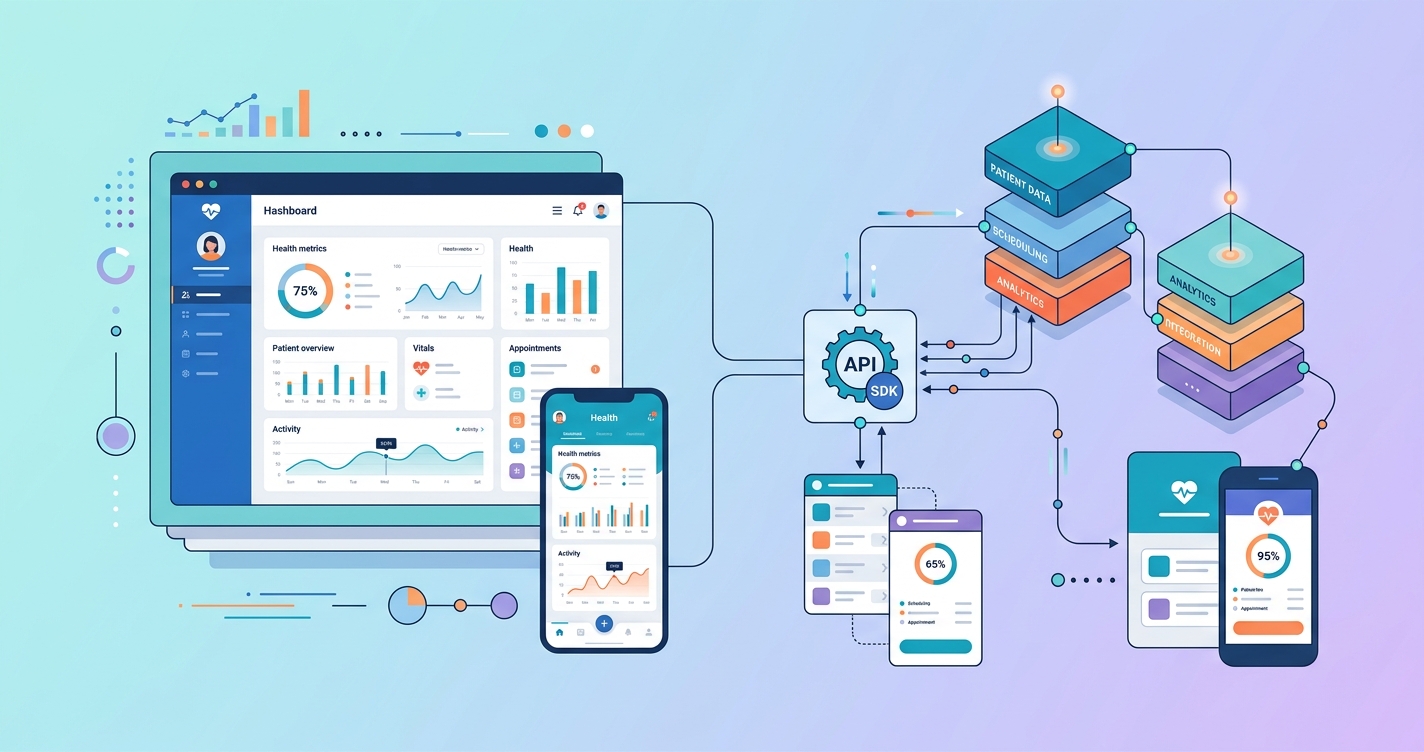
For teams evaluating white label vs embedded sdk health strategies, the real question is not which model sounds more modern. It is how much of the product you want to own, how much implementation drag your team can absorb, and where integration depth actually creates value. In digital health, that decision touches product velocity, interoperability work, governance, and the shape of your margins two years from now.
"Digital maturity is now defined by governance, integration, and accountability." — CHIME and KLAS, Digital Health Most Wired: National Trends 2025
White label vs embedded SDK health decisions usually come down to control boundaries
A white-label deployment gives a buyer a nearly finished application layer that can be branded, configured, and launched quickly. An embedded SDK gives the buyer building blocks that engineering teams place inside an existing app, portal, or workflow. Neither model is inherently better. They solve different organizational problems.
That distinction matters more in 2026 because healthcare buyers are under pressure to integrate digital tools into real operating environments. IQVIA's Digital Health Trends 2025 notes that digital health has moved into a phase shaped by tighter evidence standards, more mature reimbursement pathways, and stronger expectations around workflow integration. In practice, that means the integration model has become a board-level decision, not just an engineering preference.
| Model | What the buyer gets | Best fit | Main tradeoff |
|---|---|---|---|
| White-label platform | A branded application with configuration controls | Fast launches, new product lines, lean teams | Less UI and workflow control than a fully embedded build |
| Embedded SDK | Core functionality inserted into an existing product | Teams with an established app and strong engineering resources | More implementation work, testing, and long-term maintenance |
| Hybrid approach | White-label now, SDK later for selected workflows | Companies proving demand before deeper integration | Requires clear migration planning |
What I keep seeing in enterprise evaluations is that teams often frame this as a design question. It is usually an operating-model question instead.
Where white-label makes more sense
White-label tends to win when speed, consistency, and lower implementation burden matter more than bespoke product control.
Farnia Velayati, Haleh Ayatollahi, Morteza Hemmat, and Reza Dehghan wrote in their 2022 JMIR systematic review of telehealth business models that value proposition, financial variables, and revenue streams sit near the center of telehealth commercialization. That is useful here because white-label platforms are often strongest when a company wants to commercialize quickly without turning infrastructure into its main source of complexity.
A white-label model is usually the better fit when:
- the company needs a branded launch in weeks, not quarters
- the buyer is opening a new line of business rather than rebuilding its core app
- compliance, hosting, and baseline administration should be handled upstream
- the internal team is strong in go-to-market and workflows, but small on platform engineering
- multiple customer tenants or branded instances must be launched from one base
For hospital innovation groups, payer programs, and startup teams trying to hit a contract window, this matters. A white-label platform often shortens the path to pilot readiness because much of the application logic is already packaged.
Where an embedded SDK is the better choice
An embedded SDK starts to look more attractive when the existing application is already the primary user experience. If the product team cares deeply about keeping one login flow, one design system, one analytics layer, and one care journey, SDK depth can be worth the extra work.
This is where interoperability pressure shows up. The ONC's HTI-1 Final Rule, published in January 2024, set USCDI Version 3 as the baseline standard for the ONC Health IT Certification Program effective January 1, 2026, while also tightening expectations around API maintenance and access to electronic health information. Even if a buyer is not building a certified EHR, those policy shifts shape procurement expectations. Buyers increasingly ask whether new health functionality can plug into the systems they already run.
That usually pushes teams toward SDKs when they need:
- tighter control over user flows inside an existing app
- native connection to their own identity and access model
- custom data handling, event logging, or orchestration logic
- deeper integration with patient records, CRM, or care-management tools
- one continuous experience instead of separate branded modules
The cost is obvious: the buyer owns more of the integration burden. That means more QA, more release coordination, and more engineering dependency whenever the surrounding app changes.
Integration depth changes the economics more than the licensing model
It is tempting to compare white-label and embedded SDKs as if one is cheap and the other is expensive. That is not quite right. The real budget swing comes from integration depth.
CHIME and KLAS argue in their 2025 national trends report that high-performing organizations are no longer measuring digital progress by feature count alone. They are measuring whether governance, analytics, and interoperability are actually embedded into daily workflows. That is a useful lens because the more deeply you embed a health capability, the more your own team has to govern it.
| Evaluation factor | White-label platform | Embedded SDK |
|---|---|---|
| Time to launch | Usually faster | Usually slower |
| UI control | Moderate to high, but bounded by the platform | Very high |
| Engineering lift | Lower | Higher |
| Interoperability flexibility | Good if APIs are mature | Best when the buyer needs deep app-level control |
| Operational ownership | Shared with the platform vendor | Mostly sits with the buyer |
| Multi-tenant rollout | Often easier | Depends on the buyer's architecture |
| Long-term product differentiation | Limited at the presentation layer, stronger in service design | Stronger inside the product itself |
I think this is the part many buyers underestimate. An embedded SDK does not just add flexibility. It adds accountability. If the integration is elegant, the product feels seamless. If it is messy, the buyer ends up owning the mess.
Industry applications
Digital health startups
Startups usually choose white-label when the product thesis is still being tested. It lets them validate demand, distribution, and customer willingness to pay before committing to deeper platform work. If traction proves real, selective SDK integration can come later.
Telehealth platforms
Telehealth platforms lean toward embedded SDKs when contactless vitals need to sit inside an existing visit flow, patient app, or clinician workspace. They lean toward white-label when they are launching a separate branded portal or remote-monitoring program.
Hospitals and health systems
Hospitals often care less about surface branding and more about governance. They ask harder questions about access controls, data movement, and reporting. In those cases, the right answer depends on whether the health feature should live inside an existing patient or staff application, or operate as a separately governed service.
Current research and evidence
IQVIA's 2025 report argues that digital health is maturing into a more disciplined market where evidence, reimbursement, and system fit matter more than novelty. That lines up with what procurement teams are doing now: they want fewer disconnected tools and cleaner integration logic.
The CHIME and KLAS 2025 report reaches a similar conclusion from a health-system angle. Its main point is hard to ignore: optimization now beats expansion. In plain English, buyers want technology that works inside the workflows they already run.
The ONC HTI-1 rule adds policy pressure behind that market shift. As API and data-exchange expectations rise, a shallow integration starts looking less acceptable for enterprise programs that need reporting, governance, and reusable workflows.
Velayati, Ayatollahi, Hemmat, and Dehghan offer the business-model perspective. Their review covered 4,998 records and included 23 studies, concluding that telehealth success depends on how the model creates value and revenue, not just on technical capability. That is why white-label versus SDK is not just a product architecture choice. It is a commercialization choice.
| Source | Key finding | What it suggests for integration strategy |
|---|---|---|
| IQVIA, Digital Health Trends 2025 | Adoption depends on evidence, workflow fit, and commercialization maturity | Buyers should choose the model that can be operationalized fastest inside real care workflows |
| CHIME + KLAS, National Trends 2025 | Digital maturity is shaped by governance, integration, and accountability | Deeper integration only pays off if the organization can manage it well |
| ONC HTI-1 Final Rule (2024) | USCDI v3 becomes the baseline in 2026 and API expectations are tightening | Health products increasingly need credible data exchange paths |
| Velayati et al., JMIR (2022) | Telehealth business success depends on value proposition and financial design | White-label is often attractive when speed and commercialization matter most |
The future of white-label and embedded SDK strategies
The market does not look like it is moving toward one winner. It looks like it is moving toward more modular decisions.
I would expect three things over the next year or two:
- more buyers launching with white-label infrastructure, then embedding selected functions later
- more SDK buyers demanding stronger admin controls and multi-tenant tooling that historically sat in white-label products
- more procurement teams asking for proof that the integration model supports reporting, governance, and data portability from day one
That hybrid pattern makes sense. A company may want white-label speed for the first deployment, then deeper SDK ownership once usage patterns are clear. That is a much saner path than overbuilding too early.
Frequently asked questions
Is white-label or embedded SDK better for digital health startups?
For most early-stage startups, white-label is the faster option because it reduces engineering load and shortens time to market. An embedded SDK becomes more attractive once the startup already has a mature application and wants tighter product control.
Why do enterprise buyers often prefer deeper SDK integrations?
Because enterprise buyers usually care about identity, workflow continuity, analytics, and governance. An SDK can fit more tightly into existing apps and internal systems, though it requires more implementation work.
Does a white-label platform limit long-term differentiation?
It can limit how much of the presentation layer and in-app behavior you control. But many teams still differentiate through clinical workflows, service design, operations, customer support, and commercial packaging.
When does a hybrid approach make sense?
A hybrid approach makes sense when a company wants to launch quickly, prove demand, and then selectively embed key capabilities into its own product later. That keeps early risk lower without closing off deeper integration later.
If your team is sorting through integration depth, solutions like Circadify Custom Builds are built for companies that want a branded launch path now and room for deeper customization later.
Related reading on this site: White-Label vs Build From Scratch: Cost and Timeline Compared, What Is Multi-Tenant Architecture? Health Monitoring Platforms Explained, and White-Label Health Platform Compliance: HIPAA, SOC 2, Data Residency.